
Author : SHANTHANU Institution - Government law college, Thiruvananthapuram Course - Five-Year Integrated B.A. LL.B…
Beyond the Simulation: Launching the Municipal Community Lawyering Hub
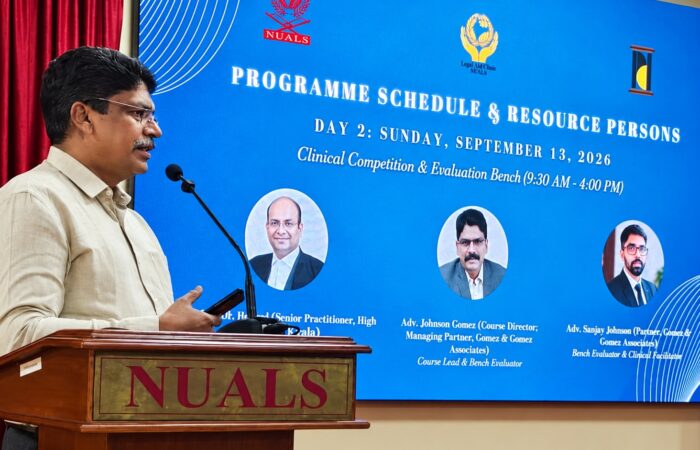
By Adv Johnson Gomez
Tomorrow, October 5, 2026, marks a profound milestone in the journey of the Project Complete Lawyer (PCL) Foundation and its dedicated team. We will be officially inaugurating Phase III of the Litigation Governance Course 2026, proudly named the Municipal Community Lawyering Hub, at the NUALS campus. The phase will be inaugurated by the Hon’ble Mayor of Cochin Municipal Corporation, Adv. V.K. Minimol, in the esteemed presence of Prof. (Dr.) G.B. Reddy, Vice-Chancellor of NUALS, and Adv. Girija Gopal, Vice-Chairperson of the Bar Council of Kerala.
This momentous occasion will also be graced by Dr. Lina Acca Mathew, Registrar of the university, alongside our dedicated faculty coordinator, Dr. Aparna Sreekumar. But equally central to tomorrow’s milestone are the 9 student clinicians themselves. It is their dedication and perseverance through the rigorous training of Phase I and Phase II that have brought us to this critical juncture. As the Course Director who has guided this initiative from its inception, standing on the eve of this launch brings forth a multitude of reflections. As we prepare to open this new chapter in clinical legal education, I wish to share some of these core thoughts with you.
To the outside observer, this might appear to be just another add-on course conducted by a not-for-profit organization within a university setting. But for the Project Complete Lawyer team, it signifies something far more profound. It is the crucial testing ground for a comprehensive clinical training protocol, one we ultimately envision scaling to law students across the entire country.
When we initially selected NUALS for this initiative, some of our peers harbored reservations. A valid concern raised within our team was the unique ecosystem of the National Law University (NLU) system. The aspirations of these students are often quite distinct from those in other legal education institutions. Naturally, many of these bright minds are heavily focused on securing coveted positions as in-house counsel or landing roles in the country’s premier corporate law firms.
Through the Litigation Governance Course, however, we were asking them to pivot. We were inviting them to step into the trenches of traditional legal practice and join the ranks of grassroots litigators and community advocates. Given that this was an experimental curriculum—one fundamentally challenging the typical corporate trajectory—there was a genuine fear that it might not be warmly received. We braced ourselves for a hesitant response.
When we shared the initial concept note, the first wave of support came almost immediately from Prof. (Dr.) G.B. Reddy, the Vice-Chancellor of NUALS, with the faculty quickly following suit. Their endorsement provided the essential opening ground we needed to proceed.
The students, however, initially struggled to grasp the full potential of this hands-on professional training model. While an encouraging 53 students enrolled at the outset, attrition soon followed. By the time we transitioned to the rigorous, face-to-face clinical simulations of Phase II, our cohort had distilled down to just nine dedicated students. It is with immense pride that I name these nine student clinicians who chose to stay the course: Aleeta Mary Eldho (5th year), Naveena Prince (4th year), Adhiti Manoj (4th year), Devika S Gopal (5th year), Sobbi Jagadeshwari Nayana (5th year), Ishan Sharan Kaushik (5th year), Anjana (4th year), Jasi Sapna (5th year), and Kavya Sanjay Menon (5th year).
I must acknowledge that logistical hurdles, such as course delays and scheduling conflicts for the in-person sessions, undoubtedly contributed to this drop-off. Yet, even if the scheduling had been flawless, I estimate we might have retained perhaps five or six more participants at best. The reality is that the majority simply declined our invitation to embrace the traditional practice of law. The demanding, grassroots nature of this innovative course inevitably acted as a filter, separating those simply curious about the concept from those truly committed to the trenches of litigation.
This natural attrition brings into sharp focus a concept that assumes critical importance here: the “practice of law.” The statutory mandate of the Bar Council, particularly in its formulation of undergraduate legal curricula, is expressly designed to prepare students for this very purpose. But what does that actually mean? Under the framework of the Advocates Act, 1961, and as authoritatively interpreted by the Supreme Court (Bar Council of India v. A.K. Balaji), the “practice of law” is not a narrow concept confined merely to standing before a judge. It is a comprehensive domain encompassing both litigious and non-litigious work, ranging from active representation before courts and tribunals, to the precise drafting of pleadings, client counseling, and strategic legal advice. The Litigation Governance Course is our attempt to bridge the gap between reading that definition in a classroom and actually executing it in society.
The most decisive and definitive way to achieve this readiness is through clinical legal education. This is an immersive process where a student is confronted with a genuine grievance directly from a client, hearing the facts straight from the horse’s mouth, and is immediately tasked with engineering a viable legal solution.
At its core, the practice of law is fundamentally about problem-solving. Whether you are navigating a complex transaction in the polished confines of a corporate office, strategizing within a premier law firm, or sitting across from a citizen in a municipal legal aid clinic, the mandate remains identical. From the very first day of your career to your last, you are expected to solve problems.
Our journey with NUALS began in early February. Over the months leading up to this October launch, we experienced profound realizations. There were unexpected challenges and serendipitous alignments, what one might call universal interferences, that caused our initial concept to grow and evolve multifold. Our research team worked tirelessly to draw the correct lines in the correct places, a process made possible only through the invaluable support of the numerous individuals and institutions who stood by us.
This narrative would be fundamentally incomplete without honoring the extraordinary contributions of our professional colleagues who anchored our training modules. We are deeply indebted to Senior Adv. M.R. Hariraj, Adv. Seema Parthasarathy, Adv. K.B. Pradeep, and Adv. T.B. Hood, whose hands-on mentorship during various sessions breathed practical life into the curriculum. Above all, we must acknowledge the profound guidance of the Hon’ble Chief Justice of the Sikkim High Court, Justice A Muhammad Mushtaq, whose support and vision have been a guiding light for this initiative.
Alongside these pillars of the profession, I must personally acknowledge the transformative contribution of Adv. Rahul A.R. from Dharmabot AI. Not only did he actively lead an insightful training session during Phase II, but his technological integration gave us the confidence to mentor a larger cohort without needing a massive physical faculty. He proved that a core group of experienced lawyers, empowered by technology, can effectively guide and monitor any number of student clinicians, transcending physical boundaries.
Equally vital was the support of our media partner, Lex Insight. Mr. Shine Vijayan, popularly known as Nalan Shine, gave us the courage to meticulously document the rigorous exercises of Phase II and broadcast tomorrow’s inauguration, ensuring our vision reaches the critical stakeholders who need to see this model in action.
What began as a conceptual desire to provide “actual training” has now materialized into a concrete institutional reality. With the Cochin Municipal Corporation joining hands with the NUALS Legal Aid Centre to establish this Lawyering Hub, these students are no longer just studying the law; they are stepping out into the community to apply everything they have mastered during Phase I and Phase II. By any standard, tomorrow is a historic milestone. Tonight, on the eve of the inauguration, the “war room” of the Project Complete Lawyer Foundation is finally at ease. There were, undeniably, several anxious moments and high-stakes decisions throughout this journey. But at the end of the day, seeing the quiet pride and happy faces among our team members, we know the struggle was entirely worth it.
But while our war room might breathe a brief sigh of relief tonight, it is not yet time for us to truly rest. I am reminded of the enduring lines by Robert Frost:
“And miles to go before I sleep, and miles to go before I sleep.”
The immediate success and positive reception of this course have already compelled us to look beyond our current horizons and think on a much larger scale. A serendipitous coincidence in this journey was our association with Adv. Deepak Prakash and Adv. Divyangana Malik, who was championing a similar vision through LexFinis. We quickly realized that the philosophies of the Project Complete Lawyer Foundation and LexFinis were almost identical. By forging this larger alliance, we are effectively shifting gears, preparing to transform the grassroots experience at the NUALS Legal Aid Centre into a comprehensive national project.
As our next decisive step, we will soon be approaching the Hon’ble Supreme Court of India with a Public Interest Litigation (PIL). This petition will seek the immediate implementation of the NALSA Regulations and the broader scheme mandating the establishment of functional legal aid centers across all law universities and local bodies. Simultaneously, we are initiating deep, empirical research to identify and resolve the operational bottlenecks that currently hinder legal aid clinics across the country.
Therefore, tomorrow’s inauguration is not merely the launch of Phase III in Kochi. It is poised to mark a profoundly historic milestone in the larger journey of reforming legal education and community justice across India.
Related Posts
Comments (0)